
【文化與學習講座】02/25 (四) _張育愷 教授 / 研發長 (國立體育大學教競技與教練科學研究所):急性健身運動與認知功能:由行為、認知神經科學至實務運用
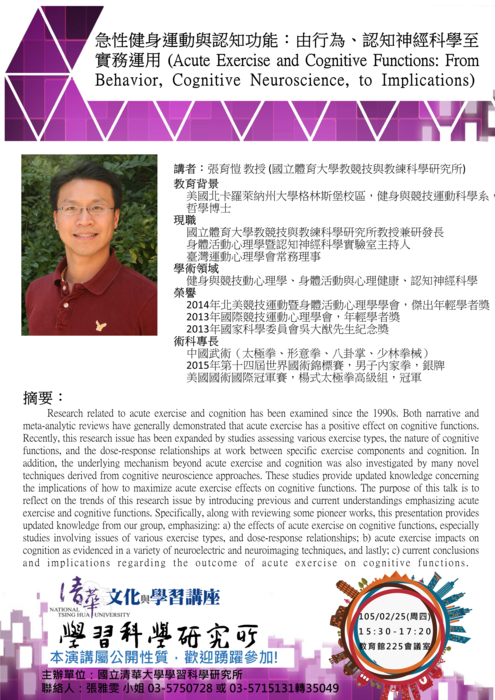
講題:急性健身運動與認知功能:由行為、認知神經科學至實務運用 (Acute Exercise and Cognitive Functions: From Behavior, Cognitive Neuroscience, to Implications)
講者:張育愷 教授/研發長 (國立體育大學教競技與教練科學研究所)
時間:105年2月25日(週四) 15:30-17:20
地點:教育館225會議室
講者簡介:
- 教育背景
美國北卡羅萊納州大學格林斯堡校區,健身與競技運動科學系,哲學博士
- 現職
國立體育大學教競技與教練科學研究所教授兼研發長
身體活動心理學暨認知神經科學實驗室主持人
臺灣運動心理學會常務理事
- 學術領域
健身與競技動心理學、身體活動與心理健康、認知神經科學
- 榮譽
2014年北美競技運動暨身體活動心理學學會,傑出年輕學者獎
2013年國際競技運動心理學會,年輕學者獎
2013年國家科學委員會吳大猷先生紀念獎
教育部102年度大專院校特殊優秀人才彈性薪資獲獎者
100至103年度國家科學委員會特殊優秀人才獎勵
中國青年救國團民國100年青年獎章:博學類別得獎者
美國北卡羅萊納州大學格林斯堡校區,傑出博士論文獎
美國應用競技運動心理學會,研究獎勵
- 術科專長
中國武術(太極拳、形意拳、八卦掌、少林拳械)
2015年第十四屆世界國術錦標賽,男子內家拳,銀牌
美國國術國際冠軍賽,楊式太極拳高級組,冠軍
美國國術國際冠軍賽,形意拳器械組,冠軍
入選當代中華武術大典之卷三「當代中華武壇菁英名錄」
演講摘要:
Research related to acute exercise and cognition has been examined since the 1990s. Both narrative and meta-analytic reviews have generally demonstrated that acute exercise has a positive effect on cognitive functions. Recently, this research issue has been expanded by studies assessing various exercise types,the nature of cognitive functions, and the dose-response relationships at work between specific exercise components and cognition. In addition, the underlying mechanism beyond acute exercise and cognition was also investigated by many novel techniques derived from cognitive neuroscience approaches. These studies provide updated knowledge concerning the implications of how to maximize acute exercise effects on cognitive functions. The purpose of this talk is to reflect on the trends of this research issue by introducing previous and current understandings emphasizing acute exercise and cognitive functions. Specifically, along with reviewing some pioneer works, this presentation provides updated knowledge from our group, emphasizing: a) the effects of acute exercise on cognitive functions, especially studies involving issues of various exercise types, and dose-response relationships; b) acute exercise impacts on cognition as evidenced in a variety of neuroelectric and neuroimaging techniques, and lastly; c) current conclusions and implications regarding the outcome of acute exercise on cognitive functions.