
【文化與學習講座】10/08 (四) 吳俊育 副教授 ( 國立交通大學教育研究所):Dealing with Complex Survey Data in Learning Sciences
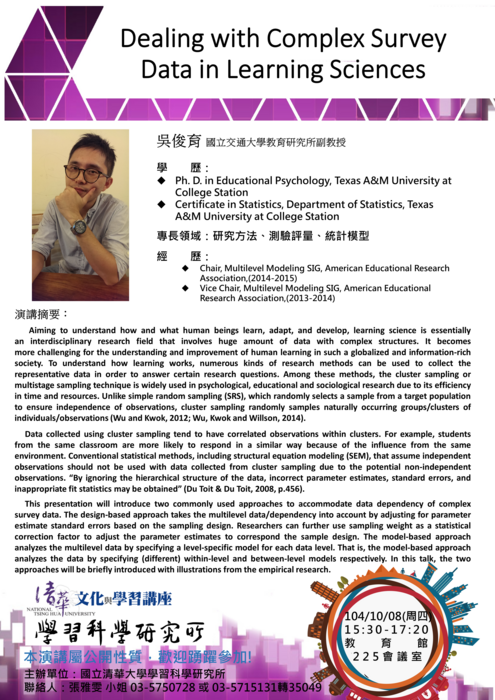
題目:Dealing with Complex Survey data in Learning Sciences
講者:吳俊育 國立交通大學教育研究所副教授
時間:104年10月08日(週四) 15:30-17:20
地點:教育館225會議室
講者簡介:
- 現 職:國立交通大學教育研究所副教授
- 學 歷:
-
Ph. D. in Educational Psychology, Texas A&M University at College Station
-
Certificate in Statistics, Department of Statistics, Texas A&M University at College Station
-
-
專長領域:研究方法、測驗評量、統計模型
- 擔 任:
-
Chair, Multilevel Modeling SIG, American Educational Research Association,(2014-2015)
-
Vice Chair, Multilevel Modeling SIG, American Educational Research Association,(2013-2014)
-
演講摘要:
Aiming to understand how and what human beings learn, adapt, and develop, learning science is essentially an interdisciplinary research field that involves huge amount of data with complex structures. It becomes more challenging for the understanding and improvement of human learning in such a globalized and information-rich society. To understand how learning works, numerous kinds of research methods can be used to collect the representative data in order to answer certain research questions. Among these methods, the cluster sampling or multistage sampling technique is widely used in psychological, educational and sociological research due to its efficiency in time and resources. Unlike simple random sampling (SRS), which randomly selects a sample from a target population to ensure independence of observations, cluster sampling randomly samples naturally occurring groups/clusters of individuals/observations (Wu and Kwok, 2012; Wu, Kwok and Willson, 2014).
Data collected using cluster sampling tend to have correlated observations within clusters. For example, students from the same classroom are more likely to respond in a similar way because of the influence from the same environment. Conventional statistical methods, including structural equation modeling (SEM), that assume independent observations should not be used with data collected from cluster sampling due to the potential non-independent observations. “By ignoring the hierarchical structure of the data, incorrect parameter estimates, standard errors, and inappropriate fit statistics may be obtained” (Du Toit & Du Toit, 2008, p.456).
This presentation will introduce two commonly used approaches to accommodate data dependency of complex survey data. The design-based approach takes the multilevel data/dependency into account by adjusting for parameter estimate standard errors based on the sampling design. Researchers can further use sampling weight as a statistical correction factor to adjust the parameter estimates to correspond the sample design. The model-based approach analyzes the multilevel data by specifying a level-specific model for each data level. That is, the model-based approach analyzes the data by specifying (different) within-level and between-level models respectively. In this talk, the two approaches will be briefly introduced with illustrations from the empirical research.