
【文化與學習講座】10/16(四)_ Alfred Deakin Professor Jill Blackmore:Disciplining female academics: Gender and restructuring Australian entrepreneurial universities
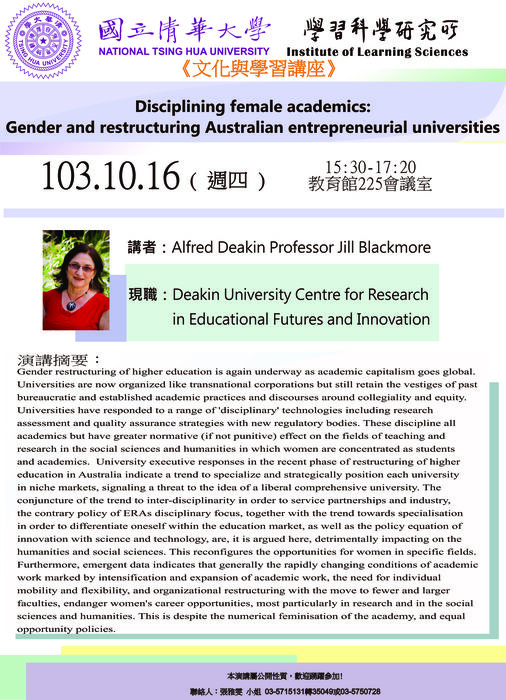
題目:Disciplining female academics: Gender and restructuring Australian entrepreneurial universities
講者:Alfred Deakin Professor Jill Blackmore
時間:103年10月16日(週四) 15:30-17:20
地點:教育館225會議室
講者簡介:
Deakin University Centre for Research in Educational Futures and Innovation
演講摘要:
Gender restructuring of higher education is again underway as academic capitalism goes global. Universities are now organized like transnational corporations but still retain the vestiges of past bureaucratic and established academic practices and discourses around collegiality and equity. Universities have responded to a range of ‘disciplinary’ technologies including research assessment and quality assurance strategies with new regulatory bodies. These discipline all academics but have greater normative (if not punitive) effect on the fields of teaching and research in the social sciences and humanities in which women are concentrated as students and academics. University executive responses in the recent phase of restructuring of higher education in Australia indicate a trend to specialize and strategically position each university in niche markets, signaling a threat to the idea of a liberal comprehensive university. The conjuncture of the trend to inter-disciplinarity in order to service partnerships and industry, the contrary policy of ERAs disciplinary focus, together with the trend towards specialisation in order to differentiate oneself within the education market, as well as the policy equation of innovation with science and technology, are, it is argued here, detrimentally impacting on the humanities and social sciences. This reconfigures the opportunities for women in specific fields. Furthermore, emergent data indicates that generally the rapidly changing conditions of academic work marked by intensification and expansion of academic work, the need for individual mobility and flexibility, and organizational restructuring with the move to fewer and larger faculties, endanger women’s career opportunities, most particularly in research and in the social sciences and humanities. This is despite the numerical feminisation of the academy, and equal opportunity policies.