
103學年度碩士班考試入學資訊(含參考書目)
學習科學研究所103學年度碩士班考試入學資訊(含參考書目)
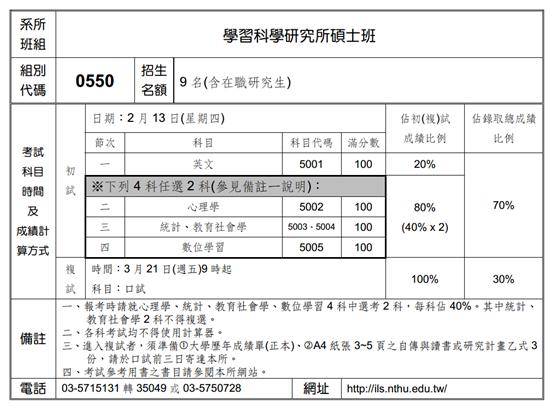
參考書目
一、心理學:
1. 陳憶貞(譯)(2003):《普通心理學》。台北:雙葉。(原著:Sternberg, R. J. (2000). Pathways to psychology (2nded.). London: Thomson Learning.)
2. 危芷芬、田意民、何明洲、高之梅(譯)(2010):《心理學導論》。台北:雙葉。(原著:Nolen-Hoeksema, S., Fredrickson, B., Loftus, G., Wagenaar, W. (2009).Atkinson &Hilgard's introduction to psychology (15thed.).Cengage Learning .)
3. 陳學志(主譯)(2010):《認知心理學》。台北:學富。(原著:Ashcraft, M. H. (2002). Cognition (3rd ed.). Pearson Education.)
4. 余伯泉等(譯)(2011):《社會心理學》。台北:揚智。(原著:Aronson, E., Wilson, T. D., &Akert, R. M. (2010). Social Psychology (7th ed.). Pearson Education.)
二、教育社會學:
1.台灣教育社會學學會(2005)。教育社會學。台北市:巨流。
2.朱道凱(譯)(2002)。Z.Bauman著。社會學動動腦(Thinking Sociologically)。台北市:群學。
三、數位學習:
請考生自行尋找與閱讀與「手持式數位科技,網路社交社群,及人機互動與介面設計等議題在學習上的應用」之相關文獻資料。考題將著重於思考辨證與設計規劃的能力,而不在記憶,但考生對於重要概念需要有一定程度的了解才能活用知識。相關重要概念包括:Game Based Learning,IPad/ Tablet PC,App之教育應用,電腦輔助合作學習(computer supported collaborative learning),學習社群(community of practice / online community), 虛擬世界的學習 (learning in virtual worlds), 知識建構(knowledge construction, constructivism)。
四、統計:
1.林清山(2011)。心理與教育統計學。台北:東華。
2.王文中(2004)。統計學與Excel資料分析之實習應用。台北縣:博碩文化。
3.黃瓊蓉、蘇文賢、江吟梓(譯)(2009)。Arthur Aron & Elaine N. Aron著。心理與教育統計學(第三版)(Statistics for psychology, 3rd ed.)。台北市:學富文化。