
【文化與學習講座】 9/22(四)吳嫻博士:The automatic and plastic mapping between numbers and space in college students and in elementary school children
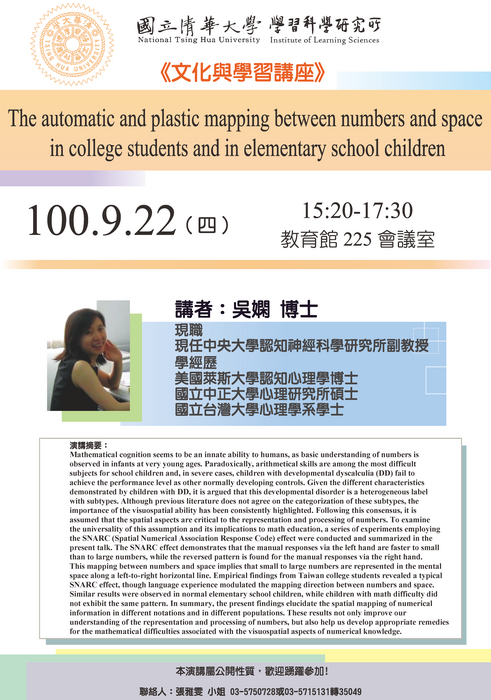
歡迎踴躍參加本所舉辦「文化與學習講座」,本次演講訊息請見下方。
題目:The automatic and plastic mapping between numbers and space in college students and in elementary school children
講者:吳嫻 博士
時間:100年9月22日(星期四)15:20-17:30
地點:教育館225會議室
講者簡介
現職:現任中央大學認知神經科學研究所副教授
學經歷:
美國萊斯大學認知心理學博士
國立中正大學心理研究所碩士
國立台灣大學心理學系學士
參考資料:/var/file/276/1276/img/1067/Chiouetal.(2009).pdf、/var/file/276/1276/img/1067/Hungetal.(2008).pdf
演講摘要:
Mathematical cognition seems to be an innate ability to humans, as basic understanding of numbers is observed in infants at very young ages. Paradoxically, arithmetical skills are among the most difficult subjects for school children and, in severe cases, children with developmental dyscalculia (DD) fail to achieve the performance level as other normally developing controls. Given the different characteristics demonstrated by children with DD, it is argued that this developmental disorder is a heterogeneous label with subtypes. Although previous literature does not agree on the categorization of these subtypes, the importance of the visuospatial ability has been consistently highlighted. Following this consensus, it is assumed that the spatial aspects are critical to the representation and processing of numbers. To examine the universality of this assumption and its implications to math education, a series of experiments employing the SNARC (Spatial Numerical Association Response Code) effect were conducted and summarized in the present talk. The SNARC effect demonstrates that the manual responses via the left hand are faster to small than to large numbers, while the reversed pattern is found for the manual responses via the right hand. This mapping between numbers and space implies that small to large numbers are represented in the mental space along a left-to-right horizontal line. Empirical findings from Taiwan college students revealed a typical SNARC effect, though language experience modulated the mapping direction between numbers and space. Similar results were observed in normal elementary school children, while children with math difficulty did not exhibit the same pattern. In summary, the present findings elucidate the spatial mapping of numerical information in different notations and in different populations. These results not only improve our understanding of the representation and processing of numbers, but also help us develop appropriate remedies for the mathematical difficulties associated with the visuospatial aspects of numerical knowledge.